

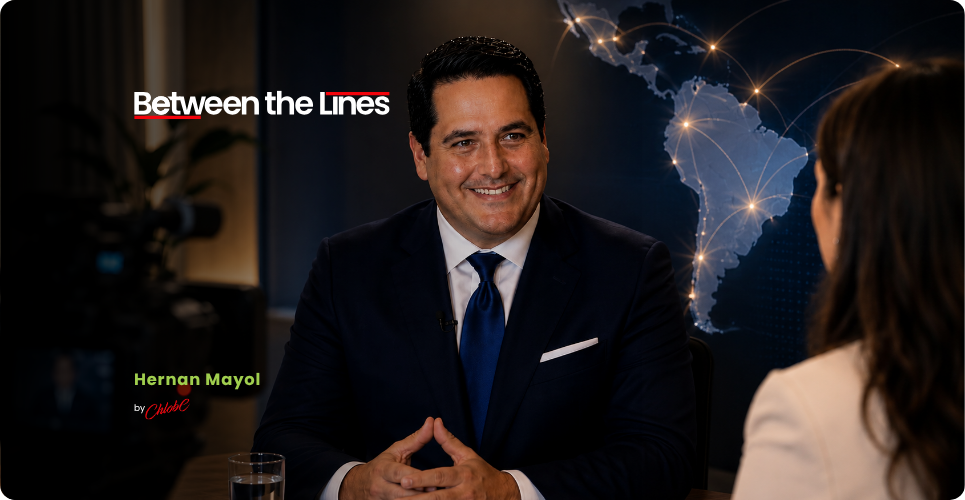
"Your career is built on people, not transactions."

Opening — The Journey
You started your banking career in the early 1990s, right as Latin America was navigating significant economic transitions. How did that timing shape the way you see risk, opportunity, and cross-border finance?
The timing was formative in ways I did not fully appreciate until much later. I entered banking right as Latin America was going through its most dramatic period of economic transformation. Brazil was fighting hyperinflation. Ecuador was on the edge of dollarization. Argentina was heading toward a collapse that would eventually shake the entire region. These were not case studies. These were my markets.

During those years I closely managed correspondent banking relationships across South America and Mexico during periods of genuine market unpredictability. I helped finance trade flows from Central America to the U.S. using factoring solutions. I helped structure transactions in some of the hemisphere's most challenging credit markets, using programs backed by the U.S. government including OPIC, EXIM Bank, and the CCC, multilaterals like the IDB and IFC, and trade credit insurance to make transactions work that conventional credit analysis would have rejected.
I also learned how to underwrite facilities and build new products for Caribbean governments and financial institutions, where patience and local understanding were as important as technical skill.
What that period gave me was a deep and practical understanding of how to separate real risk from perceived risk. I learned from some of the best bankers in the business—how to find the instrument, the structure, and the counterparty that makes a transaction possible when the environment is difficult, and how to build the kind of trust with clients and partners that sustains a relationship through the hard moments as well as the good ones.
That is the most valuable education I have ever received, and it happened in the field, not in a classroom.

You’ve built a career that spans some of the biggest names in global banking. When you look back, was there a defining moment that shaped the direction your career would take?
My path as a global leader was truly defined upon joining Bank of America in 2007. After the bank divested its BankBoston LatAm operations to Banco Itau, its corporate trade finance footprint in the region had become quite limited. While the bank maintained solid ties with local large firms and U.S. subsidiaries, these were almost exclusively focused on payments. The bank feared losing those global relationships as competitive pressure intensified.
I was hired to lead the re-establishment of the trade and supply chain business across the region and make it profitable. The real challenge lay in expanding local connections while quickly building the product framework needed to finance cross-border operations between continents.

What followed was one of the most challenging and rewarding experiences of my career. We built one of the largest and most respected trade and supply chain franchises in the region, completing landmark transactions across Brazil, Mexico, Chile, Colombia, and Peru with a team that truly believed in what we were creating.
That experience shaped how I think about leadership. It is about having the vision and courage to make a dramatic impact. Anyone can manage something that already exists. The real test is whether you can see the opportunity others are missing, move with urgency, and build something that outlasts your time in the role. I learned that I could—and that knowledge has stayed with me in every room I have walked into since.
Banreservas & The U.S. Expansion
Banreservas recently expanded into New York, Miami, and Madrid. What does it mean for a Dominican state-owned institution to plant its flag in these global financial markets?

It means the Dominican Republic believes in helping its people wherever they are. The diaspora has given so much back to their country. They left home, built lives abroad, and never stopped sending money back, investing in their communities, and keeping their connection to the island alive.
Banreservas being in New York, Miami, and Madrid is a promise kept by the Government of the Dominican Republic, helping Dominicans abroad build a prosperous future back in their home country. It is a statement of national pride and a long overdue act of gratitude toward a community that has never stopped believing in home. I am honored every day to help deliver on that promise.

The Dominican Republic has been one of the fastest-growing economies in Latin America. What are the most important things U.S. and international partners still don’t fully understand about that market?
They still don’t understand the pace of the country’s transformation. Most partners are still operating on an outdated picture of what the DR is. This is one of the fastest growing economies in Latin America, with a diversified base across tourism, manufacturing, energy, real estate, and remittances.
The regulatory environment has matured significantly. The business community is internationally connected and increasingly sophisticated.

What international partners and investors underestimate is how much genuine opportunity exists there for those who take the time to understand the market properly rather than approaching it with assumptions formed decades ago.

You’ve spoken about Banreservas serving as a financial bridge for the Dominican diaspora. How do you think about the role of diaspora banking as both a business model and a social mission?
For me it goes hand in hand to make a real impact. Take ours as an example. The Dominican diaspora is one of the most economically active immigrant communities in the United States. Dominicans send billions of dollars home every year to support their families, and also invest in their own future by buying retirement homes on the island. These are typically far more affordable than equivalent properties in the U.S., where prices have become exponentially higher.

When you serve diaspora communities adequately, you are not simply generating revenue. You are helping families realize a dream they have carried for decades—the dream of building something secure back home. The business model and the social mission are intertwined. They reinforce each other rather than compete with each other.
This is why I view "diaspora banking" as a crucial, yet often overlooked, prospect in the current international financial landscape. It demands a combination of strategic leadership, clear vision, and a genuine commitment to providing support that extends far beyond immediate financial returns.
Trade Finance & The Evolving Landscape
You’ve spent over 30 years in trade finance. How would you explain its importance to someone outside the industry, and why does it matter especially for Latin America?
I always highlight this. Almost nothing you use in a given day reached you without trade finance working behind the scenes. The coffee in your cup, the clothes you are wearing, the phone in your hand. Trade finance is what happens behind the scenes. This financial intermediation is what allows a buyer on one side of the world to do business with a seller they have never met, because financial institutions assist in the process to make sure both sides honor their commitments.
For Latin America that matters even more than most people realize. So much of the region’s growth depends on small and mid-sized exporters being able to reach global markets, and trade finance is what makes that possible. Without it, a great product sitting in a warehouse in Peru or Honduras never makes it to the buyer who wants it on the other side of the world.
Trade finance is not a side function of economic development in this region. It is one of its primary engines.

Banks focused on trade finance in Latin America need to return their attention to trade flows, documentation, and cross-border regulatory risk. What’s gotten lost in recent years, and what would a course correction look like?
The mistake the industry has made is believing that superior technology could replace the core of banking principles. It cannot. A digitized letter of credit is still a letter of credit. It still requires someone who understands the underlying trade flow, the documentation requirements, and the regulatory environment in every country involved. What got lost was the depth of expertise that used to be standard in this business.
The course correction starts with people, not platforms. Banks need to reinvest in training the next generation of trade finance professionals to understand the fundamentals as well as the technology, and then let the technology amplify that expertise rather than substitute for it.

How is technology—AI, digital rails, and blockchain-based trade platforms actually changing trade finance operations on the ground? Where do you see real adoption versus hype?
What I have seen on the ground is a clear gap between innovation that solves a real operational problem and innovation that sounds impressive in a conference presentation.
Digitized documentation and improving payment rails solve a real problem. They make transactions faster and more reliable, so adoption has followed.
Blockchain trade platforms promised to solve a real problem too, counterparty trust, but the solution required too much coordination across too many independent players, so adoption has lagged.
AI is earning its place because it improves something banks already do, assessing risk and detecting fraud, rather than asking the entire ecosystem to change how it operates. That may take a little longer.


Leadership, Boards & Governance
You’ve served ITFA for many years in roles from Americas Chair to Fintech Liaison to board member. What does long-term service to a professional organization teach you about leadership that you simply can’t learn inside a company?
It teaches you that real leadership is rooted in service, not status. When you chair a committee in an association, you are not managing employees who answer to you. You are convening volunteers, competitors, and busy executives who are giving you their time for free because they believe the work matters. There is no obligation holding anyone in the room except the value of what you are building together.
That demands a different kind of leadership than running a department inside a bank, where people show up because it is their job. At ITFA, leadership is something earned by consistently delivering on your commitments.
And because the work touches the entire industry rather than a single institution, the impact of your actions reaches far beyond your own organization. People across the industry recognize that, and it builds a form of credibility you simply cannot replicate inside the walls of one company.

You’ve also sat on several boards across your career. What’s the most important thing an executive needs to understand before stepping into a board role for the first time?
Before stepping onto a board, an executive needs to understand their unique value proposition.
Across my board experience, my contribution has always centered on cross-border financing, risk management, and a broad network built over thirty years that few other board members may have.
I do not have all the answers, but I know the people who do. I focus on being the most valuable voice on the topics where my experience genuinely matters, and that focus is what earns you a seat at the table.


The Human Side
You founded Apprentice Worldwide, a global mentoring network for young professionals and entrepreneurs. What drove you to build that—and what do you wish someone had told you at the beginning of your career?

I lost my father and mentor early in my career, and that loss left a void at exactly the stage when I needed guidance most. What I found in the years that followed were other mentors who stepped in, often without realizing it. People who believed in me before I believed in myself and gave me their time when they had no obligation to do so. That generosity changed the trajectory of my life.
That gap is ultimately what became Apprentice Worldwide. Together with some of my closest friends, and people I had met along the way throughout my career, many experienced executives and business owners who understood exactly what that transition feels like, I built a community designed to provide the guidance and support that young professionals so badly need at that stage.
I wanted to help college graduates navigate the transition into the real world and beyond, a stage of life that is far harder than people give it credit for, and to make sure they never had to face it without the kind of support that changed my own trajectory.
What I wish I had known from the start is simple. Your career is built on people, not transactions. I spent too many early years focused on proving myself through results, when the thing that actually carried me forward was every relationship I invested in along the way, especially the ones that did not pay off immediately.
That lesson eventually became the foundation of everything I built afterward, including Apprentice Worldwide itself.

Most people don’t know this about you, but you’ve also pursued a program in Spiritual Direction at St. Thomas University. How does that dimension of your life inform how you lead?
It taught me to listen at a deeper level. Spiritual Direction is fundamentally a practice of accompanying someone on their journey without imposing your own agenda on it. You learn to be fully present, to hear what is being said beneath what is being said, and to hold space for uncertainty rather than rushing to fill it with answers.
I try to bring that same quality of presence to my leadership. When I sit with a team member, a client, or a mentee, I am not just processing information. I am trying to understand what they actually need, which is often different from what they are asking for.
In a world that is increasingly transactional and fast moving, that quality of attention is rare. And I believe it is one of the most powerful things a leader can offer.

Entre Líneas is about the lines between the résumé and the real story. So — what’s something your career biography doesn’t capture about who you are or how you got here?
What it does not capture is what it cost. International banking at this level demands sacrifice that is rarely visible in a resume. Years of travel. Moments with family that cannot be recovered. A partner who held everything together at home while I was building things far away, and who never once asked for recognition she more than deserved.
My wife has been the foundation of my life and my career in ways that no biography will ever adequately reflect. And the mentors, the teammates, and the friends who contributed along the way are equally invisible in that document.
The resume tells you what I built. It does not tell you who I built it with or what it cost all of us to get here.

Looking Ahead
If you had to name one shift happening right now in Latin American financial services that you think the industry is underestimating, what would it be?
The shift I see that the industry is consistently underestimating is the speed of digital adoption among Latin American consumers and small businesses. The region has leapfrogged traditional banking infrastructure in ways that are still not fully appreciated by the major institutions.
Mobile payments, digital wallets, and fintech platforms are not supplementing the banking system in Latin America anymore. In many markets they are replacing it. The institutions that treat digital as a channel rather than a transformation are going to find themselves in a very difficult position over the next decade.
Behind all of that technology there is still a human being who needs guidance, trust, and a financial partner that truly understands their reality. Someone needs to take care of them.
And the institutions that combine digital capability with genuine human commitment to their clients are the ones that will define the future of banking in this region.


What’s next for Hernán Mayol — personally and professionally?
From a professional standpoint, I am currently in an exceptional position. My role at Banreservas allows me to perform work that bridges an institution, a community, and a nation, which is incredibly rewarding. This comes on the heels of my time with the Small Business Administration, where I supported underbanked exporter groups in the United States following the pandemic. There is still much to build and much to contribute, and that sense of purpose drives me every single day.
At the same time, I remain deeply committed to serving the broader financial industry through my ongoing work at ITFA and other local organizations. These platforms allow me to advocate for best practices and foster the international cooperation necessary for growth. I am also dedicated to investing in the next generation of talent through intentional mentorship.
Personally the next chapter is about what truly matters. More time with the people I love. Deeper investment in the faith and the relationships that have always grounded me. And being a great example to my girls, who I am enormously proud of, in everything I do and everything I stand for.
I have been given far more than I ever expected in this life. Giving back with intention and gratitude is what comes next.